Why to Travel? Is it seriously to explore new places or try out new cuisines or have an experience about different culture or food habits? Or it is just to load your instagram with fancy selfies and fish around for more double-taps or check in at new airports and let the world know that you can afford to travel? Is it seriously for yourself or a status quotient?
If you are travelling to save your social status amongst your network then its seriously an issue that you must give a thought. In this era of global village, where you are stuck between presentations and EMI's, you hardly get to know who lives on the other end of your apartment. If you are getting a chance to explore then you must go on with discovering your inner peace and exploring things that probably you won't even dream about while you are in your conference room. Some of you might find it strange but there are people who are more bothered about their facebook likes on their pout selfie in front of an international airport than have the real fun of travelling.
I like to travel. Whenever I go around to explore a new place I either do it alone or with the least possible company. Having someone with whom you can share a similar thought is what matters more to me than a group of noise making dissimilar crowd. That gives me a lot of benefits. I get peace which isn't so easily available these days. I get to know the place better as lesser people means lesser priorities and more similarities. Also, if I am travelling with someone special then it gives me a chance to know the other person better. It is about discovering our common likeness and common dislikeness.
How do you define learning? If it is mugging up big books and jolting them down then seriously you are being trained to be a parrot. You are just repeating things that is already felt, discovered or jolted by somebody else without even contributing anything to it. That won't help anybody. Obviously some teacher who is not accustomed to innovation would have given you good grades, but he has obviously killed the little left zeal of innovation in you.
Learning is gaining knowledge. I believe the best way is to travel and learn. The thrill and adventure teaches you that there is no charm in waiting for the destination, but the worth is in valuing your journey.
Travelling brings you across new cultures, new people, new places, nature, terrain and food habits. It is said that culture and food habits change every 100 kilometres and what is more fun in travelling across such varied forms of cultures and food habits.
Travelling also develops your micro-mentality in to a broader prospective. You forget to differentiate across people by the caste, community, religion and wealth. When you stay inside your home you forget to love your neighbours, when you live only amidst your neighbours you forget the other parts of the city, when you live only in your city you forget the other places in your state, when you live only in your state you forget the rest of the country, but when you travel like the whole world is your home you are not confined to restricted thoughts in your mind.
Travelling also drives away the inner fear of home-sickness. I have seen a lot of people around who could achieve big but they refrained themselves from doing so because of their inability to give up with their home-sickness.
I was always discouraged by my friends to try trekking because of my weight. I did a lot of things which people of my weight generally refrain themselves fearing adverse consequences. I was never encouraged by anyone to trek up across rocks to a ice filled hill. If ever I tried, nobody was there to motivate me. Last year, when I stood below one such icy hill I was again lacking motivation from within and surrounding. When I saw a few people nearby mocking me because of my weight I gave up the fear and got up to the topmost peak without anybody's help. I did it and I am proud of it. They who tried to mock me, gave up in between. I accomplished another fear of life. I could do that because I travelled to a new place and that led me to discover a different part of me inside me.
Life is such a journey which is not possible to learn it all. In fact, nobody has ever known the whole of it. Travelling just lets you know a different part of it everyday. So I believe in the mantra - Travel and Learn.
Nature
is always an underrated beauty. There is more thrill in travelling to explore
nature, culture and customs, than just travelling to places to try out cuisines
and shopping around. Barbados is a dream destination for all nature lovers. With
tide pools, cliffs, coral reefs, underground lakes and caves, coral rocks
and beaches with palm trees the island stands as one of the most sought after
travel inspiration destinations across the world. The land is an unspoilt haven
for many creatures and houses some of the indigenous flora and fauna.
Barbados
is an island country in southeastern Caribbean Sea, covering an area of 432
square kilometres. English is the official language of the country. Barbados
has tropical monsoon climate round the year with mild breeze. The period from
June to November witnesses rain in the entire climate.
The
playful waves and pink sand makes the Crane Beach one among the top beaches of
the world. The gentle breeze that sways the coconut grooves also adds to it
beauty. The beach is famous for Boogie boarding and body surfing. The beach has
always been a favourite for honeymooners. The Crane Beach Resort, located near
the beach ensures great stay for the visitors and also ensures every possible
comfort to the visitors.
Bathsheba
is a rugged beach towards the eastern coast. At Bathsheba beach, large rock
formations stand in the beach giving the view of picturesque beauty. These
rocks are broken rock formations from the ancient coral reef. The pools of
Bathsheba are carved in inshore coral reefs. Visitors sit in them with a drink
and enjoy the enriching experience of the natural whirlpool created in them.
Oistins
Bay Garden is a small fishing town towards the south coast. Different vendors
have different cooking style. They have wide range of fish and meat which is
prepared in front of the customers. People take their seat in informal setting
and enjoy their food while enjoying music. During weekends, late night visits
general keep the customers waiting for long time as the queue gets longer. Art
and craft items like jewellery, pottery, wood carvings, pottery, clothing and
accessories are also available for sale at the beach.
Bajan
Bus is one of the historic treasures of this island country. The bus gives the
tourists a tour around the scenic beauty, the life of locals and sights of some
of the photogenic places. The bus takes around 30 passengers on shared basis or
rent. The bus stops for a rum punch and buffet lunch.
Andromeda
Botanic Gardens houses several flowering plants and tropical plants. The garden
houses, humming birds, resident monkeys and over six hundred different variety
of plants. The garden is a delight for horticulturists. There is also a cafe and a place nearby to buy crafts.
The
Atlantis Submarine tour is a forty minute journey to 150 feet below the sea
level and allows visitors to the sea the sea bed as a playground. The journey
leaves the visitors enthralled by the view of amazing coral formations and sea
life. The co-pilot shares different information and adventures about the
sea life.
Barbados
Earthwork Pottery is located near St. Thomas and it manufactures some of the
attractive and usable pottery in the finest class. Dinnerware and serving
pieces come in 150 shapes and 36 patterns. The entry is free but the aesthetic tempts almost every visitor to buy a gift or a dinner piece. This Caribbean
pottery place is a must visit.
Barbados
is the birthplace of oldest distilled spirit – rum. Mount Gay Distillery,
founded in 1703 is believed to be the oldest manufacturer of rum. Rum has been
the essence of Caribbean culture and Barbados rum is considered to be the best
rum in the world. There are several recipes of rum across Barbados and each the
uniqueness of each recipe adds a better experience of self-exploration.
The
nightlife at this island is also highly appreciated. There are plenty of places
to grab a cocktail, dance, play arcade games or even set out on a dinner
cruise. There are plenty of festivals happening all throughout the year where
crowd from all around the year drop in.
A
visit to this island will definitely prove to be more than awesome. The
experience here starts with a gentle smile, goes on with inquisitiveness,
builds more delight with every different facet of the island and leaves
everyone with an urge to visit again. The narrows roads and colourful lives give
a wonderful experience of Caribbean culture exploration.
This post is submitted for Lufthansa's #TheBlindList contest. So pack your bags and #SayYesToTheWorld.
In the year 1489, when Sankardeva reached Kochbehar, the then King of Koch - Rajbangshi dynasty Maharaja Naranarayan requested him to preach and spread the teachings of the Neo-Vaishnava cult. In his honour, the king built the Satra in the 16th century. Guru Sankardeva breathed his last at this Satra in the year 1568. The present Satra has been innaugrated by the then Cheif Minister of Assam Bimala Chandra Chaliha in the presence of the then Cheif Minister of West Bengal Prafulla C Sen. Lakshmikanta Mahanta is the present Satradhikar of the Satra.
We started our journey early morning from Beparipatty, Gauripur. We anticipated a huge rush and hence started early. We were excited to head towards the place with such religious sanctity. We reached Kochbehar after a journey of 3 hours and headed towards Madhupur More in a shared tempo. To our astonishment, there wasn't even a single gate showing the entrance to the Satra. After being dropped by the tempo, we enquired with several local shops if we were on the correct path or not. We never imagined a place with such religious importance without a gate. We headed towards the Satra in an electric rickshaw, locally known by the name 'Toto'.
The view of Madhupur More. There isn't any gate to welcome you to the Satra. Electric Rickshaws stand there to facilitate your conveyance to the Satra.
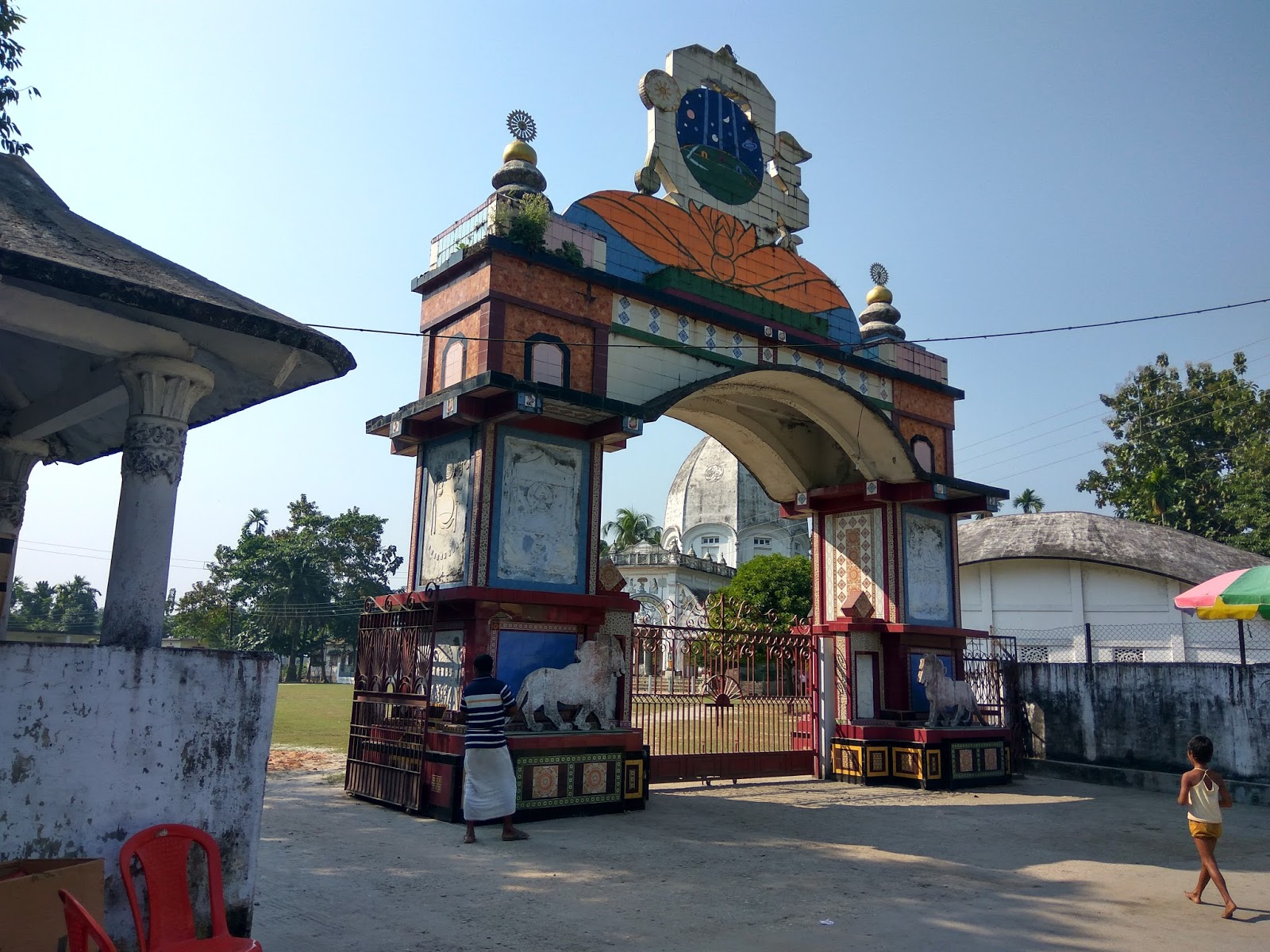
The gate just outside the Satra
There are a couple of bookstalls outside the Satra which has books of Sankardeva and his teachings. These stalls also hold several things for worship at the Satra.
Book stalls and hand carts outside the Satra.
The view of Madhupur Satra
The Kirtan Ghar of MadhupurSatra
Some preachings of Sankardeva inscribed on the walls of the Satra
A side view of the Satra
Another view of the Satra walls
The Satra also holds a lamp which has been lighting since about five hundred years
With an young priest of the Temple
We were disappointed to see only few devotees there. The Satradhikar and other priests of the Satra welcomed us whole heartedly and they also asked us for an overnight halt. The Satradhikar spoke to us on various religious issues and also shared various facets and memoirs associated with the Satra. We were really motivated to hear him speak. We sat beside him and listened to him; an aura of positivity soon surrounded us.
Satradhikar Lakshmikanta Mahanta speaking with devotees who visited the Satra
Satradhikar Lakshmkanta Mahanta speaking to one of the devotees
The famous Gunamala (গুণমালা) which was written by Sankardeva in one night as per the request of Koch King Naranarayana is also preserved in this sacred place. The book contains rhyming and sonorous verses and it is considered as a handbook of Bhagwata Purana. The historical significance of the book goes back to a debate between King Naranarayana and his pandits. When the court poets asked for a condensed version of the entire ten cantos of the Bhagwata Purana overnight, all the poets refused. However Sankardeva took the challenge and accomplished it. The booklet was kept in a wooden box, painted yellow and red and elephant was drawn within the circumference of the circle. He signified that he had squeezed an elephant into a lime pot (হাতী মাৰি ভুৰুকাত ভৰোৱা). He exhibited his extraordinary skills of breivity and impressed King Naranarayana. The last remains of Sankardeva and Madhavdeva are preserved here. There are also certain important things like the Paduka's of Sankardeva and the bronze pen used by him. These last remains are displayed twice in a year. Once in the time of Rash and the next in the anniversary of the first Satradhikar, which is two or three days before Saraswati Puja. Another important fact of this place is that the first ten Satradhikar's of this place left for heir heavenly abode on the same day.
Satradhikar Lakshmikanta Mahanta also spoke about the various problems the Satra was facing. He was disappointed that there were very few visitors to the Satra. He expressed that he would have been delighted if more visitors visited the place. He also said that the financial support towards a place that holds high historical importance of Assamese culture is very low and that it needs more support from the government. The Satradhikar is suffering from kidney ailments and he also expressed his disappointment that nobody visits the Satra to enquire about his health. He was hospitalized a few days back in Guwahati Medical College and Hospital (G.M.C.H) and there were handful of visitors to visit him.
Madhupur Satra is one of those places which holds high importance, both for the followers of Hindu Dharma as well as for the Assamese culture. The place with such sanctity is now facing scarcity of recognition. This place is also important hotspot for tourism for people from Assam.
I have always admired travelling to places that are blessed with nature's presence and filled all around with picturesque beauty. I have admired the beauty of the hills and the serenity. My dream lies in travelling lands that are saturated with picturesque beauty with the company of only a couple of near and dear ones. Peace and serenity is something that I feel is worth paying for always.
Bhutan, a land of monasteries and impregnated with nature is one of my dream destinations. One of the sought after places in the country is the Tiger Nest Monastery. The monastery hangs off at a cliff, above blue pines and rhododendrons. People take can take a pony to some part of the place, but on towards the monastery their is steep walk and narrow roads. The narrow roads take up to a waterfalls nearby through the snow lion cave. This is the place where Guru Rinpoche bought Buddhism to Bhutan on the back of a tigress. Paro valley, which is also an example of God's masterpiece creation is visible from this place.
Tiger Nest Monastery
Paro Valley
The Punakha Dzong, which is the second largest Dzong in the entire country is considered a very sacred place and also considered as a place of utmost happiness. The place is located at a juncture of two rivers, Pho Chu and Mo Chu. Interestingly, both the rivers belong to separate genders. The place is covered with jacaranda trees which bloom on during the entire summer and the place is connected to the mainland through a wooden bridge.
Punakha Dzong
The peak of Zuri Dzong Trek is another worth mentioning site that mesmerized tourists around the globe for hours and hours. The place has also a cave where Budhha came in 8th Century to meditate.
The Phobjikha and Gangtey valley are also places that shall make alive the human inside everyone else. The black necked crane, which is considered as an endangered species is found in this place. A wide range of plant and animal habitat fills around this place and tourists capture unforgettable moments for lifetime during their visit to this place.
Gangtey Valley
A small town with clean environment to catch up for amazing view of a growing culture along with nature is visible well in Phuentsholing.
Phuentsholing
Bumthang valley is considered the spiritual heartland of the country and there are several ancient and precious religious sites at this place. Temples and apple trees are widely found in this entire region.
Bumthang Valley
Thimphu, the country's capital is a conglomerate of history and modernization. Buildings in Bhutanese architecture are seen there are those are built only up to a certain height.
Thimphu
Thimphu
Wangduephodrang district is the one of the lands where cattle rearing is clearly visible in pastureland's. Also various bamboo handcrafts are made at this place.
Wangduephodrang district
This land is a piece of God's excellent creation and where nature dwells happily. A visit to this land would introduce the people to an extraordinarily remarkable habitat and would also mesmerize the tourists. One can take an album of beautiful pictures away from this place on the visit to this beautiful habitat.
I don't want to settle in any narrow corner of the world and get confined to any territory. I want to travel the entire world.
Before I step ahead and travel the entire world, I am much eager to explore the place from where I belong - North-East India.
I am born in midst of extreme natural beauty. Greenery, Wildlife, Snow and overflowing rivers are the sites that I have always wanted to dwell across ever since a child. Five places I would like to explore as an amateur traveler are -
1. Sivasagar
Sivasagar is town located in Upper Assam, 360 Kilometers from Guwahati. Sivasagar was previously the capital of Ahom Kingdom. It is the home to many ancient heritages.
Devidol is the temple of Hindu Goddess Durga that has been standing tall for three centuries. The architecture speaks all about the Golden days of Assam History.
Sivadol is one of the tallest Shiva temple of the world. It was built about three centuries back. The center of attraction there mainly is the gigantic architecture and religious values. It has three temples built on the bank of Sivasagar Tank. All the three were built by Queen Ambika, wife of King Shiva Singha.
Kareng Ghar is a four storied building and arranged in gradually receding towers of which only two can be seen.The top floor has a dome like roof with a chamber. The groud floor has three west facing halls with a front and rear chamber. The palace is well secured by digging canals around the place and then building fort like walls around it.
Ranghar is a double storied royal pavilion of Ahom Kings with unique architectural features. It ias an unique amphitheater built by the Ahom Kings, which symbolizes the pride of Ahom Kingdom. It resembles the Roman Colosseum in the fact that Ahom Kings used this as a platform of enjoying sports.
2. Teesta & Rangit River
The nearest town to access there two rivers is Kalimpong. White Water rafting has been one of my childhood wishes. Rivers for ages have been the arteries of communication and culture, today can be explored for sports and recreation. The spells of swift, intense encounters with foaming, roaring waters are punctuated by many more longer periods of gentle floating with opportunities to observe natural wonders along continuously varying canvas of the river banks.
3. Manas Wildlife Sanctuary
Manas Wildlife Sanctuary, Assam is one of the biodiversity hot spot. The scenic beauty includes a range of forested hills, alluvial grasslands and tropical evergreen forests. The site provides critical and viable habitat for rare and endangered species including tiger, greater one-horned rhino, swamp deer, pygmy hog, and Bengal florican. Manas has exceptional importance with the Indian sub-continents protected areas, as one of the most significant remaining natural areas in the region, where size able populations of large number of threatened species continue to survive.
4. Hornbill Festival
Hornbill festival is celebrated every year in between 1st to 10th December in Naga Heritage Village, Kisama which is around 12 Kms from Kohima. The festival shows a melange of cultural display under one roof. All the tribes of Nagaland take part in this festival. The festival aims to protect the rich and varied culture of the state. The week long festival unites one and all in Nagaland and people enjoy the colorful performances, crafts, sports, food, games and ceremonies. Traditional arts include paintings, wood carvings and sculptures. Festival highlights include traditional Naga Morungs Exhibition and sale of arts and crafts, food stalls, Herbal Medicine stalls, flower shows and sales, Cultural Medley - songs and dances, fashion shows, Beauty Contest, Traditional Archery, Naga Wrestling, Indigenous games and musical concert.
5. Mawlynnong Village
Mawlynnong Village in East Khasi Hills, also referred to as 'Gods Own Garden' , has won the acclaim of being the cleanest village in Asia in 2003. Mawlynnong is located 90 Kms from Shillong and 92 Kms from Cherapunjee. The onus to keep the village clean lies with every person residing in the village. Local cleaning the roads, picking up leaves and throwing garbage in the bin is a common sight. Bamboo garbage bins adorn every nook and corner of the village highlight the consciousness of cleanliness among the villagers. Cleanliness is an old tradition and a way of life for all villagers. The village gives an experience of walking on a live root bridge, 85 feet tall sky walk and a breath taking view of Bangladesh Border. Suprisingly the village has 100 percent literacy rate.
 If you are travelling to save your social status amongst your network then its seriously an issue that you must give a thought. In this era of global village, where you are stuck between presentations and EMI's, you hardly get to know who lives on the other end of your apartment. If you are getting a chance to explore then you must go on with discovering your inner peace and exploring things that probably you won't even dream about while you are in your conference room. Some of you might find it strange but there are people who are more bothered about their facebook likes on their pout selfie in front of an international airport than have the real fun of travelling.