Showing posts with label Asamese Culture. Show all posts

Friday, April 19, 2019

Panei - Jonki

Panei - Jonki is the story of a girl named Panei and a boy named Jonki. They hailed from Lakhimpur, Assam and belonged to the Mising tribe of Assamese community. Panei was born to Niroma (mother) and Tamod (father) who were farmers from a poor family. Jonki's parents had expured since he was kid and he grew up in the village amongst other village families. They were residents of the Subansiri Miri Gaon which was based besides the river Subansiri. 

The Mising tribe is tribe originating from the hills. However continuous warfare has bought them to the plains. They worship clouds, thunder, moon, sun, stars and land. They offer wine, pork and chicken as a offering to the nature. 

Panei, who was then about 8-9 years old was playing besides the river. Jonki, who was then 14-15 years old was also there. Suddenly a bear came out of the forest. The duo got afraid and ran away from there. Panei stumbled upon the rocks. Jonki came back and helped her get up and both of them fled together. 

After some years, when it was the seventh day of Kati Bihu and there was a feast at the village with pork and chicken. While taking the blessings from the priest, Panei-Jonki sat together. Even during the feast when the group got divided on the basis of gender, they sat in oppositie to each other. After the feast, the Priest was asked about the well being of the village and then there he gave an indication that something untoward might turn up for one of the village couple. The village youth danced Bihu till late evening, when Jonki called Panei near him and asked her to meet him as he had something to discuss with her. Panei agreed to  meet him besides the river Subansiri. Accordingly, they met by the banks of river Subansiri. 

Jonki was eager to know if Panei has any likeness for him. He was also confused whether she had anything for Komud (the village Headman's son). Panei confessed that she like Jonki and denied of any likeness towards Komud. Jonki wanted to know if Panei's parents would allow them to get married. Panei asked him to work hard and earn and some money and only then she would be able to convince her parents for Jonki. 

Panei's parents were also worried for her wedding as she was growing old. Niroma wanted her to get married to Jonki but Tomud didn't. Tomud wanted her to get married to Komud as her future would be secured and he would get handsome money as offering. Niroma insisted Tomud to take Panei's consent to which he disagreed. Instead he asked Niroma to speak about Komud to Panei as she would probably grow some affection towards him. Panei, who had gone to fetch water from the river heard her parents discussing about Komud as she returned.

Panei met Jonki and asked how much had he earned by then. Jonki could earn only twenty bucks and said it would take him another six months to earn twenty bucks more and only then he would be able to talk to her parents about their marriage. 

Niroma discussed with Panei regarding Komud. Panei disagreed to the marriage offer and insisted on remaining unmarried. 

Six-seven days later, Komud reached to ask for Panei's hand and offered some monetary offering and seeked blessing. 

Jonki had left the village and was staying at Ghunaxuti, at his maternal aunt's place. His proficiency with Bihu and musical instruments made him famous amoung the young folks of Ghunaxuti. Dalimi, was one of the best Bihu dancers of Ghunaxuti. They started dancing Bihu together. Whenever Jonki would go to the banks of Subansiri to know about the how-abouts of Panei, Dalimi would be sad. Although she knew nothing about Panei, yet Jonki's absence left her sad. Gradually Jonki said Dalimi about his stay at Subansiri Miri Gaon and Panei. Dalimi was heart broken as she had started developing liking towards Jonki. 

Niroma and Tomud often insisted Panei to get married to Komud. However, she always denied. They even left the young couple alone at times so that they could start a conversation but seeing Panei's anger Komud never dared to speak a word. On several attempts, finally Panei said about Jonki. Tomud got furious and he went to the extent of saying that he would disown her as his child if she ever spoke of getting married to Jonki. 

Dalimi's father had few boats. Jonki asked Dalimi to lend him a boat as he intended to elope with Panei. Jonki said about Panei's sufferings and that left Dalimi in tears. She arranged for the boat.

Panei-Jonki eloped. They stopped near a dense forest. They parked the boat by the bank and stayed in the forest for the night. The let the boat go and wandered by the forest. At evenings, they would take shelter in a forest near Ghunaxuti. The villagemen who were in search of Panei went to Ghunaxuti and found Jonki missing. They were sure that the duo had eloped together. Jonki would gather vegetables and eatables with the money that he saved from Ghunaxuti and they managed to stay in that manner for a month. 

One evening while they were sitting beside the bonfire, Komud along with fifteen other villagemen appeared and they caught the duo. Jonki was taken in to custody by Tomud. There was a tremendous fight between Jonki and Komud. However the tribesmen attacked Jonki and only then Jonki settled. Dalimi's father arrived there with other viillagemen and stopped the fight. Even after being surrounded by such a huge mob, Jonki warned Komud to stay away from Panei or else he would have to face dire consequences.

The matter reached  the court of Lakhimpur. Numerous charges of theft, robbery and kidnapping were levied upon Jonki by Komud, Tomud and other villagemen. The court took Panei's statement and could find out that all the charges were false. The court however asked Panei's parents to take her and added that during her stay with her parents, neither Komud nor Jonki could disturb her. Panei's parents assured that they would settle the matter amongst themselves.

Panei was taken by her parents. Jonki returned to Ghunaxuti. Panei was greeted by her friends on her return. Some villagemen also insulted her. Panei's parents again insisted her to get married to Komud. She said that either she would stay unmarried or would marry Jonki. If forced, she would die willingly.

Komud's father also decided that either he would take the offered money back or would get Komud married to Panei.

Dalimi said Jonki that she has seen his villagemmen go towards the jungle and then she sent her father with a few villagers of Ghunaxuti to save them. She did the best to save the couple. 

Panei eloped again. She learnt that her parents were planning to forcefully get her married to Komud.

The viillagemen again came to Ghunaxuti in search of Jonki at his maternal aunt's home. Jonki got angry and said that Panei had eloped only because of the forceful attempts made by her parents to get married. The villagemen left. Dalimi heard the news and bought whatever money she had saved to Jonki. Jonki also said that he would go in search of Panei. 

Panei's parents realised their mistake. Niroma would often blame Tomud. Tomud, who has hard-hearted all the while was now feeling sad for his daughter. Jonki reached their place asked for their blessings. Panei's parents requested him to bring her out if he had hid her anywhere. Jonki denied, took their blessings and left in search of Panei.

After two days of wandering Panei, reached a Hindu village nearby. They lived a young gentleman whom Panei approached for water. By evening he insisted her for some wine and taking advantage of her intoxication he tried to molest her. Panei was a strong Mising girl and she successfully resisted his attempt. She was about to leave when he got back to his senses. He apologised and asked her to stay overnight. She forgave him and stayed there. 

Jonki was was also searching Panei reached the same place two days later. By the time he reached there, Panei had already left. He again left in search of her. On the way, he was kidnapped and they took his money. After three days and three nights of walking they reached a village above a hill. They gave him dry meat to eat. He could understand that he was taken as a captive and that  he had to stay there as a servant. He stayed there for four months.

One day, while he was working he saw some men bring few women as captives. He could see Jonki in them. They met and decided to elope. They were caught by the villagemen. They were decorated to be thieves. A village court comprising of the village elderly prove them to be thieves. They were tied with a single rope. Jonki prayed that Panei should be spared as she was pregnant. The villagemen gave no ear. They were pulled to the river banks.

It was already six months since Panei had left. Niroma would often blame Tomud. One day, she saw Panei-Jonki in her dream who were in a mountain. They refused to come down. They said it was impossible. They were happy. After Niroma woke up she went to the bank to fetch water. She spotted two bodies grabbed in each other arms flowing with the river. As the villagemen pulled the bodies they could make out it was Panei-Jonki. They were stabbed by sharp bamboos. They left the world in each other's arms.

The eternal love  story of Panei-Jonki shall be forever remembered by the people of this part of the country.

Saturday, February 23, 2019

Few Traditions of Northeastern India

We have several traditions which we have been following since ages. However, traditions must be kept apart from superstitions. Superstitions are those activities which are related to happenings of unnatural or supernatural reactions after certain set of actions. Traditions are age old rituals that we have been following without any belief of action-reaction.
Pork with Mustard Greens

Most of our Northeastern India cuisines are coooked with herbs than spices. Most of our foods are boiled with herbs and thus giving our food disparate taste than spicy dishes. We even have our meat with herbs or even with sesame seeds. This keeps us safe from bowel disorders and also giving us the necessary food nutrients along with taste of meat. 

Betel Leaves and Areca Nut


Betel leaves and areca nut has always been our mouth refreshner. We have it after meals and it is also offered to guests as a token of respect. While it might seem strange to some people there is basic science hidden in there.  Betel leaves and areca nut are basic whereas most of our meals contains food that are acidic. If you remember the simple science equation -

Acid + Base = Salt + Water

We Northeasterns are always on the frontfoot while welcoming guests to look in to our culture and food habits. We strongly believe and propagate the tradiiton of 'Athithi Devo Bhava'. We also feel good if our guests share a bit of their traditions with us. This gives us a chance to experience the goodness of different cultures and communities. Our tradition of 'Athithi Devo Bhava' is well evident from the foreign tourists and delegates who visit us every year. We are simple but sensitive people and we only get agitated when our simplicity is taken for granted. 

We Northeasterns can proudly claim that unlike rest of the country, gender disparity doesn't exist here. We never had any tradition of dowry in history and even today we don't expect any gifts or lump sum in marriages. We believe in a grand feast and we strong believe in 'Eat, live and party'. Even if there are reported incidents of dowry ever because of influence from other communities we strongly discourage it. We believing in celebrating the union of two souls with food and wine rather than selling our daughters to a well educated employed eligible groom. In fact, in certain places you can see that men are the weaker gender and our markets and businesses are dominated by women. There are hardly any cases of female infanticide, female foeticide or post marriage women harrasments. Also, we never had any tradition to separate the women folk in to a corner of the house during menstruation. We respect our women folk. We are Northeasterns and its our tradition and we are proud of it.

We are proud of our traditional attires and which have also turned in to our fashion today. We don't hesitate to wear our tradtitional attire in any of our main events. We might attend classes wearing jeans or be present in mettings wearing formals, but when it comes to anything important we wear our taditional dress. Some of our traditional dresses are Sherdukpen shawls and Apatani jackets (Arunachal Pradesh), Mekhela and Chador (Assam), Phanek and Innaphi (Manipur), Eking and Jainkup (Meghalaya), Puan and Kawrchei (Mizoram), Ratapfe and Naga shawls (Nagaland), Thokro and Kho (Sikkim), Rignai and Rituku (Tripura). 

Submitted for Indispire

Wednesday, October 17, 2018

Significance of Areca Nuts and Betel Leaves in North-Eastern India

Don't be surprised if you are welcomed in to a North-Eastern family with Areca Nuts and Betel Leaves instead of any soft drink. It is an integral part of our culture. It is called 'Tamul Paan' in Assamese and Nagamese, 'Kua' in Manipur, 'Kuhva' in Mizoram, 'Kwai' by the Khasi's of Meghalaya and 'Gue' by the Garo's of Meghalaya. 

Chewing Areca Nut and Betel Leaves is being followed as a custom since thousands of years. Famous traveller Ibn Battuta describes the ritual as, "The betel is a tree which is cultivated in the same manner as the grape-vine. The betel has no fruit and is cultivated for the sake of its leaves. The manner of its use is that before eating it one takes areca nut; this is like a nutmeg but is broken up until it is reduced to small pellets  and one places these in the mouth and chews them. Then he takes the leaf of betel, puts a little chalk on them and masticates them along with the betel." Tobacco stands as an optional addition with the betel leaves. 
Chopped Areca Nuts offered with betel leaves and lime

In Assamese culture the host places small pieces of areca nuts with betel leaves to the guests as an honour and conversations go on with offerings of tea and areca nuts with betel leaf. When wedding invitations are given with areca nuts and betel leaf, it signifies that the host family honours the guest and is very keen for the guest. Newly wed couples seeks blessings from the elderly by offering areca nuts and betel leaf. During bihu,  areca nuts and betel leaf are offered to the Fire God along with sesame seeds and laru-pitha.  Areca nuts and betel leaf are also given as felicitations. 

Areca Nuts with Betel Leaves

In Khasi culture, they carry small packets of  areca nuts and betel leaf. Their day goes on with  areca nuts and betel leaf. They offer it to every visitor. There is also a humorous belief that when someone has left for his heavenly demise, he has gone to have 'Kwai' with God. Most  people carry a small bag of areca nuts with betel leaves and they rarely go out of stock.

In Manipur, women sells heaps of areca nuts with betel leaves in the market which goes from Assam, Bangladesh and Myanmar. Grooms are welcomed to the wedding by offering areca nuts with betel leaves in a brass plate. 

The craze for areca nuts with betel leaves is same in Mizoram also and local shops are seen selling Kuhva Hring in small packets and locals consume it. 

Nagamese people also love tamul and it is mostly consumed post meal. It is believed that it enhances digestion.
Areca Nut Trees

However the craze for areca nuts with betel leaves is not seen in Arunachal Pradesh and Tripura. 

Areca nuts with betel leaves are elements of high respect in North Eastern culture and a guests denial to the offering by the host will obviously be disappointing for the host. It is also believed that there are several health benefits from the consumption of areca nuts with betel leaves. It keeps people warm in winters. It is believed to cure impotence, help in digestion and a remedy for tooth decays. 
x

Sunday, August 26, 2018

Deodhani Festival - Kamakhya Temple

Deodhani festival is a three day long festival which is celebrated at the intersection of 'Sawan' and 'Bhado' month as per the Assamese calendar. Situated atop the Nilachal Hills, the Kamakhya Temple in Guwahati is dedicated to Goddess Kamakhya, a consort of Lord Shiva. The temple is considered to be the principle seat of the Hindu cult of Shakti. The temple comes alive with the celebration of the Deodhani Festival which forms the core of rituals related to worship of Ma Manasha (Serpentine Goddess). During the festival the temple is full of drum beats and priests chanting prayers.

Two Deodhas dancing at the Deodhani Festival

The Deodha of Lord Shiva


The temple dancers or 'Deodhas' get possessed by spirits of Hindu Gods and Goddesses. The Deodhas dance to drum beats which are continuously played by drum groups. There is no uniform dance form, but each Deodha dances as per the dance form of the God or Goddess who has possessed him. The male temple dancers are smeared with colour and sacrificial blood. The Deodhas also carry the swords of the corresponding God and Goddess. The preparations of the festival starts a month back, when the Deodhas leave their home and start sleeping nearby the temple of the corresponding God or Goddess who is going to possess him. The Deodhas consume boiled rice and vegetables and no form of non veg is allowed. A slightest mistake in following the rituals would lead to the God or Goddess being angry on him and not getting possessed to him and which is believed to be inauspicious for the particular Deodha. One of highlighted moment of the entire festival is when the Deodhas get up on the sharp end of 'Dao' (a form of Assamese sword) and dances above it without hurting himself. Three or more Deodhas get up on the Dao and whose number and person is selected by the mutual agreement of all the Deodhas. The Deodhas defy their age and health during the course of the festival. There are several Deodhas who are senior citizens and they too get up on the Dao bearing all risks, only for the devotion to Goddess Kamakhya. Before getting up on the Dao, they take the blessings from Goddess Kamakhya and also young girls (Kumari's). They believe the Goddess Kamakhya resides in the heart of the young girls and so seeking their blessings is significant. During the course of the festival, offerings of goats and pigeons are made, which is because of the belief that they get supernatural powers from the Goddess. They also drink the blood of the offerings they make. After the death or default of any old Deodha, a new person gets possessed by the God or Goddess. While he can be recognized by the sudden movements that are caused by the possession, still he is being questioned with certain questions about the Goddess to establish his authenticity of the purpose.


Another Deodha


A Deodha dancing to the drum beats
The Deodhas roaming around the Kamakhya Temple with the Kumaris leading their way.

After the dance they take three rounds around the temple and take some rest. Visitors meet the Deodhas and seek their blessings during this time. On the last day, the festival continues till dawn. The Deodas have to get their possessed God and Goddess leave their body. It is painful to watch the session and it continues for hours. The family members of the Deodhas go in to tears seeing their near and dear one in such pain. The Deodhas leave their temple and start staying at their home after few days of the end of Deodhani festival.  


A Deodha standing on the sharp dend of Dao.


Another Deodha

It is believed that seeking blessings from the Deodhas can get your long dreamt wishes fulfilled and so visitors visit the temple and wait for the Deodhas to take rest and seek their blessings.


Two Deodhas dancing


A Deodha with his sword


My maternal Grandfathers elder brother Late Shiva Das, was the Deodha of Goddess Dakshina Kali for nearly 50 years and till his death until 2 years back, he was performing all the rituals without any dint. Just before the last Deodhani festival, he had a small accident and couldn't walk properly. On the day of Deodhani, he danced with the sword on one hand and a stick to support his broken leg on the other.


Another Deodha with his sword


My mother's Grandfather, Late Faguna Das was the Deodha of Goddess Chalanta. While he was on his early forties, on the first day of Deodhani he expired. When he was laid for his cremation the Deodhani drums started to beat. To everyone's amaze, he stood up from the pyre and ran to the temple where his sword was kept. He danced till the end. After the festival was over he returned home. My grandmother who was the youngest daughter says she was very delighted to see him back. I know most of you shall find it hard to believe, but I myself have spoken to a few of the funeral visitors and everyone has said the same story. While most of the funeral visitors are themselves dead, the ones who are alive are very old and they still get amazed when they recall the incident. He lived for near about thirty years after the incident and was the Deodha of Goddess Chalanta till his death.


Kamakhya resides in the heart of Guwahati city and it is well connected by public and as well as rented cabs. Two new hotels have also come up for accommodation. Kamakhya is well known for the homestay facility provided by the locals where they welcome every guest with their heart. The kitchens of Kamakhya are famous for the delicacies that are cooked in them.

Tuesday, November 15, 2016

Madhupur Satra

In the year 1489, when Sankardeva reached Kochbehar, the then King of Koch - Rajbangshi dynasty Maharaja Naranarayan requested him to preach and spread the teachings of the Neo-Vaishnava cult. In his honour, the king built the Satra in the 16th century. Guru Sankardeva breathed his last at this Satra in the year 1568.  The present Satra has been innaugrated by the then Cheif Minister of Assam Bimala Chandra Chaliha in the presence of the then Cheif Minister of West Bengal Prafulla C Sen. Lakshmikanta Mahanta is the present Satradhikar of the Satra.
 
We started our journey early morning from Beparipatty, Gauripur. We anticipated a huge rush and hence started early. We were excited to head towards the place with such religious sanctity. We reached Kochbehar after a journey of 3 hours and headed towards Madhupur More in a shared tempo. To our astonishment, there wasn't even a single gate showing the entrance to the Satra. After being dropped by the tempo, we enquired with several local shops if we were on the correct path or not. We never imagined a place with such religious importance without a gate. We headed towards the Satra in an electric rickshaw, locally known by the name 'Toto'.
 
The view of Madhupur More. There isn't any gate to welcome you to the Satra. Electric Rickshaws stand there to facilitate your conveyance to the Satra.
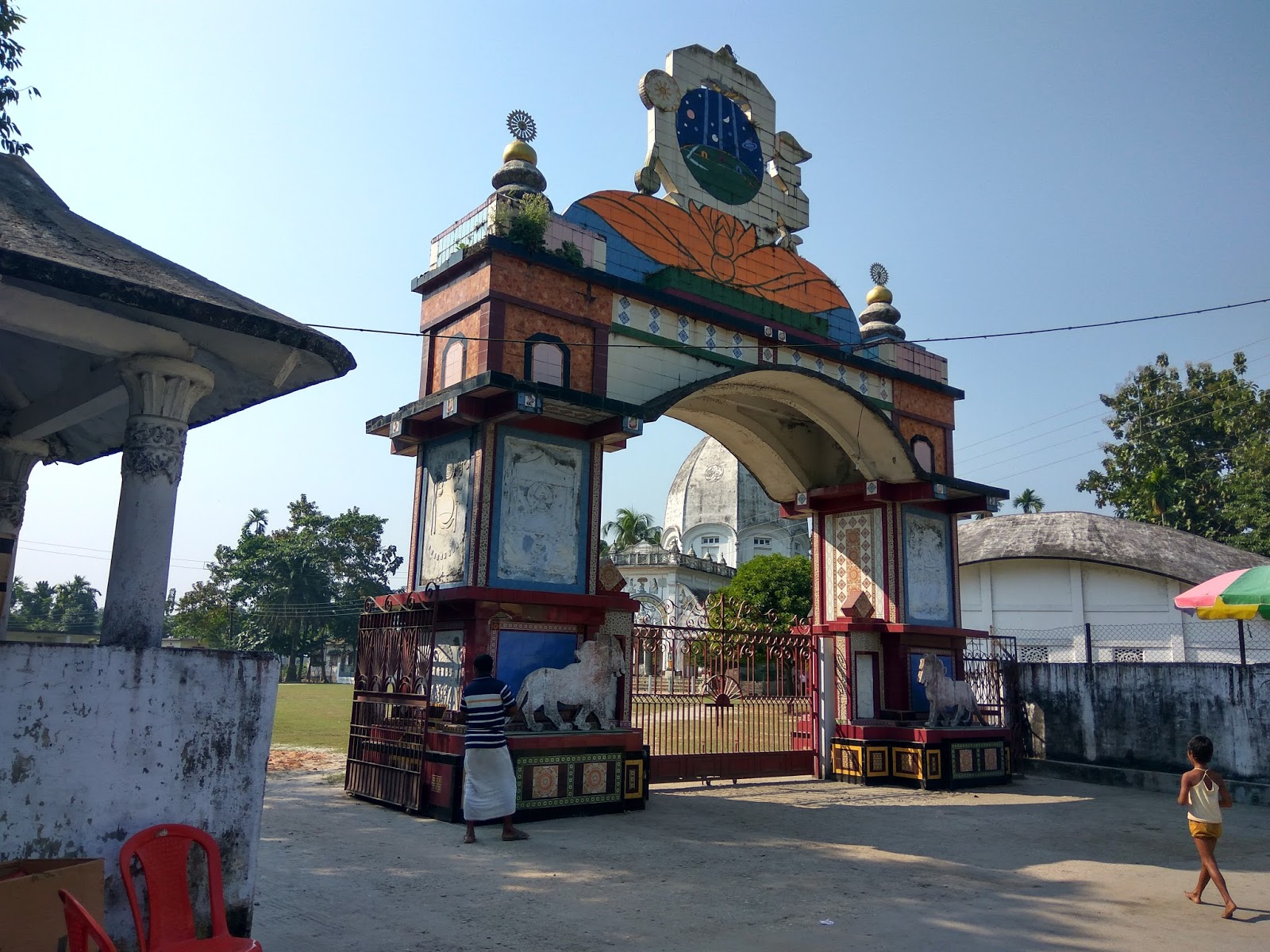
The gate just outside the Satra
There are a couple of bookstalls outside the Satra which has books of Sankardeva and his teachings. These stalls also hold several things for worship at the Satra.

Book stalls and hand carts outside the Satra.


The view of Madhupur Satra


The Kirtan Ghar of MadhupurSatra
Some preachings of Sankardeva inscribed on the walls of the Satra

A side view of the Satra
 
Another view of the Satra walls

The Satra also holds a lamp which has been lighting since about five hundred years

With an young priest of the Temple

 
We were disappointed to see only few devotees there. The Satradhikar and other priests of the Satra welcomed us whole heartedly and they also asked us for an overnight halt. The Satradhikar spoke to us on various religious issues and also shared various facets and memoirs associated with the Satra. We were really motivated to hear him speak. We sat beside him and listened to him; an aura of positivity soon surrounded us.

Satradhikar Lakshmikanta Mahanta speaking with devotees who visited the Satra

Satradhikar Lakshmkanta Mahanta speaking to one of the devotees
The famous Gunamala (গুণমালা) which was written by Sankardeva in one night as per the request of Koch King Naranarayana  is also preserved in this sacred place. The book contains rhyming and sonorous verses and it is considered as a handbook of Bhagwata Purana. The historical significance of the book goes back to a debate between King Naranarayana and his pandits. When the court poets asked for a condensed version of the entire ten cantos of the Bhagwata Purana overnight, all the poets refused. However Sankardeva took the challenge and accomplished it. The booklet was kept in a wooden box, painted yellow and red and elephant was drawn within the circumference of the circle. He signified that he had squeezed an elephant into a lime pot (হাতী মাà§°ি ভুà§°ুকাত ভৰোà§±া). He exhibited his extraordinary skills of breivity and impressed King Naranarayana.

The last remains of Sankardeva and Madhavdeva are preserved here. There are also certain important things like the Paduka's of Sankardeva and the bronze pen used by him. These last remains are displayed twice in a year. Once in the time of Rash and the next in the anniversary of the first Satradhikar, which is two or three days before Saraswati Puja. Another important fact of this place is that the first ten Satradhikar's of this place left for heir heavenly abode on the same day.

 
Satradhikar Lakshmikanta Mahanta also spoke about the various problems the Satra was facing. He was disappointed that there were very few visitors to the Satra. He expressed that he would have been delighted if more visitors visited the place. He also said that the financial support towards a place that holds high historical importance of Assamese culture is very low and that it needs more support from  the government. The Satradhikar is suffering from kidney ailments and he also expressed his disappointment that nobody visits the Satra to enquire about his health. He was hospitalized a few days back in Guwahati Medical College and Hospital (G.M.C.H) and there were handful of visitors to visit him.

Madhupur Satra is one of those places which holds high importance, both for the followers of Hindu Dharma as well as for the Assamese culture. The place with such sanctity is now facing scarcity of recognition. This place is also important hotspot for tourism for people from Assam.